The Funding Series · Part 1 of 7
The Complete Guide to Startup Funding: Pre-Seed to Series D
What each funding stage really means, how much you raise, what investors expect, and how ownership changes as you climb the ladder. The map before the journey.

In this guide
Startup funding looks, from the outside, like a series of increasingly large cheques. Founders talk about raising a seed, then a Series A, then a B, as if each is simply a bigger version of the last. It is not. Each stage exists to fund a different question, and each investor is buying a different kind of proof.
Understanding the whole ladder before you step on it is worth more than any single fundraising tactic. It tells you what you are really raising for, what you will have to prove, and what you will give up to get there. This guide is the map. The detailed posts on each stage are the terrain.
What startup funding actually is
At its simplest, equity funding is a trade: an investor gives you cash today in exchange for a share of everything the company becomes. You are selling a slice of the future to buy the resources to build it.
That trade has two consequences founders sometimes underestimate. The first is dilution: every share you sell means you own a smaller percentage of the company. The second is expectation: an investor who buys equity is not lending you money to repay, they are betting the whole company will become far more valuable, and they expect you to run it toward that outcome. Debt wants to be paid back. Equity wants to grow many times over.
This is why funding comes in stages rather than one large cheque. A young company is too uncertain to value well, and an investor will not hand over years of runway on an unproven idea. Instead, you raise just enough to reach the next proof point, that proof lowers the risk, and the lower risk unlocks the next, larger round at a higher price. Each stage buys the evidence that makes the next stage possible.
The ladder at a glance
Here is the whole journey in one view. Amounts are approximate and vary a lot by market. In Africa, rounds are often denominated in US dollars and tend to sit at the lower end of these ranges, though that gap is closing.
- Pre-seed funds the idea and the first version of the product. Roughly 50,000 to 500,000 dollars. Investors are backing the founder and the insight, because there is little else to see yet.
- Seed funds the search for product-market fit: getting a real product into real customers’ hands and finding out whether they keep using and paying. Roughly 500,000 to 3 million dollars. Investors want early signs that something is working.
- Series A funds a repeatable growth engine. You have found what works; now you fund the machine that does it again and again. Roughly 3 to 15 million dollars. Investors want proof that growth is predictable, not lucky.
- Series B funds scale: pouring fuel on an engine that already runs, expanding into new markets, segments or products. Roughly 15 million dollars and up. Investors want efficient, durable growth and a clear path to market leadership.
- Series C funds market leadership and the road to an exit: aggressive expansion, acquisitions and IPO preparation. Often 50 million dollars and up. The investors change here, to growth-equity and crossover funds.
- Series D funds the final push before an exit, either accelerating a rocket or buying time to reach a stronger IPO or sale. Frequently 100 million dollars and up, from private equity, hedge and crossover funds.
Notice the pattern. Each stage is defined by what you have proven, not by how much you raise. The money is a consequence of the milestone, not the goal.
To put real numbers on it, Carta’s 2025 data shows US median round sizes climbing from roughly 1 million dollars at pre-seed to around 4 million at seed, with median pre-money valuations of about 16 million at seed, 49 million at Series A and 119 million at Series B. The most sobering figure is the drop-off between rungs: of companies that raised a seed in 2022, only 15.4% raised a Series A within two years, down from over 30% for the 2018 cohort. Climbing the ladder has become materially harder, which is exactly why each stage’s milestone matters so much.
What changes as you climb
The single most useful thing to understand about the ladder is how the basis of the decision shifts at each rung. Early on, investors buy a story. Later, they buy numbers. The higher you climb, the less your narrative matters and the more your metrics do.
- At pre-seed, there is almost no data, so investors back the founder, the size of the problem, and the sharpness of the insight.
- At seed, they look for early evidence: are people using the product, coming back, and paying?
- At Series A, they demand a repeatable model: clear unit economics, predictable customer acquisition, real retention.
- At Series B, they underwrite efficiency at scale: is growth durable, are the economics improving as you get bigger, and can this become a market leader?
Your pitch deck follows the same arc. A pre-seed deck sells a vision; a Series B deck defends a spreadsheet. Each stage post in this series covers exactly what belongs in the deck at that rung.
How instruments differ from rounds
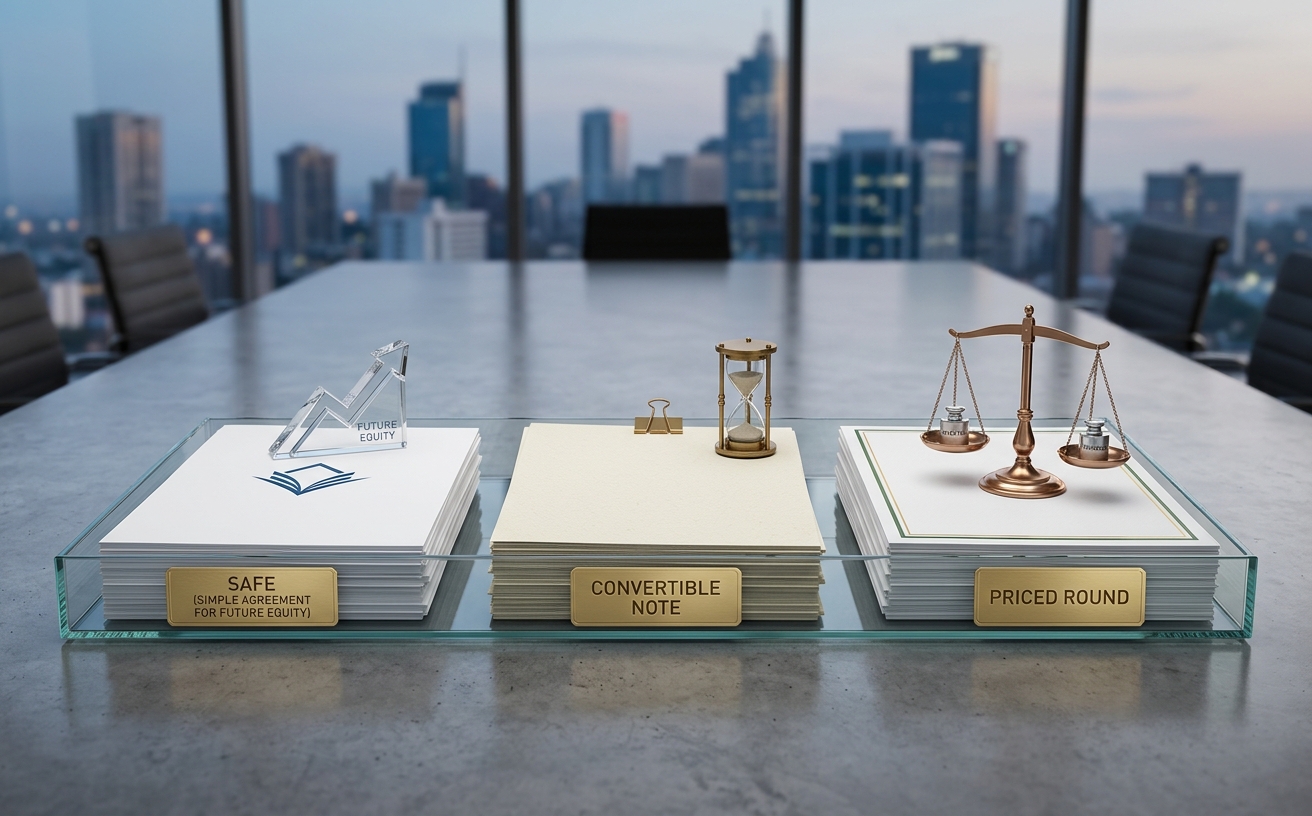
There are two ways the money can actually come in, and founders often confuse them.
A priced round sets a formal valuation and issues shares immediately. Everyone knows exactly what percentage they own the day it closes. This is standard from Series A onward.
An instrument like a SAFE or a convertible note delays the valuation. The investor gives you money now and the right to convert into shares at your next priced round, usually at a discount and often subject to a valuation cap. Early stages lean on these because pricing a company with no revenue is guesswork, and a SAFE lets you raise quickly without forcing that argument. We cover SAFEs, convertible notes and how to choose between them in dedicated posts later in this series.
Dilution: what you give up
Every round sells a slice of the company, and those slices compound. A rough picture of a founder who raises the full ladder:
- Start: founders own 100 percent.
- Pre-seed sells around 10 to 15 percent.
- Seed sells around 15 to 20 percent.
- Series A sells around 20 percent.
- Series B sells around 15 to 20 percent.
- Add an option pool for employees at each stage.
By Series B, founders commonly hold somewhere between 40 and 60 percent between them, sometimes less. That is not a failure; a smaller slice of a far larger, well-funded company is usually worth far more than all of a small one. But it is a reason to raise deliberately. Every round should buy enough progress to more than justify the ownership it costs. We break down startup valuation and cap tables and dilution in full in dedicated posts.
The African context
The ladder works the same way across Africa, but with real differences worth planning for. The scale is different too: African tech raised 4.1 billion dollars in 2025 per Partech, but a striking 41% of that was debt rather than equity, and seed funding actually fell to 462 million dollars across 311 rounds, down 38% from the 2022 peak. Three differences follow.
- Dollar rounds. Many African startups raise in US dollars while earning in local currency. That protects the investor from devaluation and puts the currency risk on the company, which makes the discipline in our piece on surviving a falling currency essential.
- A thinner later-stage market. There are far more pre-seed and seed cheques available on the continent than Series A and B ones. The step from seed to Series A is where many African companies stall, because the bar, real revenue and clean unit economics, is unforgiving.
- A wider cast of investors. Alongside angels and VCs, development finance institutions (DFIs), family offices, and diaspora investors play a larger role than in many Western markets, and each looks for slightly different things.
None of this changes the fundamentals. It changes the preparation. An African founder who walks in with genuinely clean numbers stands out precisely because the bar has been so hard to clear.
Which stage are you at?
Founders often think they are one stage further along than investors do. A quick, honest test:
- If you have an idea and maybe a prototype, you are at pre-seed.
- If you have a live product and a handful of real, paying users, you are at seed.
- If you have consistent revenue growth and can show it costs you a predictable amount to win a customer who stays, you are at Series A.
- If that engine is running efficiently and you are ready to expand it across markets or products, you are at Series B.
Match your raise to where you actually are, not where you hope to be. Asking Series A investors to fund a seed-stage company is the fastest way to a polite no.
Before you raise anything
Whatever stage you are at, three things make every conversation easier, and every valuation higher. Know the three numbers investors check first. Make sure your financial model reasons rather than just projects. And once you have money in, keep your backers close with investor updates that keep the money coming.
The rest of this series takes each rung in turn: what the stage is, what investors look for, and exactly what belongs in your deck. Start wherever you stand.
FAQ
Frequently asked questions
What are the stages of startup funding?
The common ladder runs pre-seed, seed, Series A, Series B, and then later rounds (Series C onward). Each stage funds a specific milestone: pre-seed builds the first version, seed finds product-market fit, Series A proves a repeatable growth engine, and Series B scales it.
How much equity do founders give up per round?
A priced round typically sells 10 to 25 percent of the company, with 15 to 20 percent being common. Across pre-seed to Series B, founders often move from owning nearly all of the business to owning roughly 40 to 60 percent, depending on how many rounds they raise and at what valuations.
Do I have to raise every stage in order?
No. Many strong businesses skip stages, combine them, or never raise venture capital at all. The ladder is a common pattern, not a rule. Raise only when a specific milestone needs capital you cannot generate from the business itself.
What is the difference between a priced round and a SAFE?
A priced round sets a valuation and issues shares immediately. A SAFE or convertible note delays the valuation, giving investors the right to convert into shares at the next priced round, usually at a discount. Early stages often use SAFEs or notes because pricing a young company is hard.